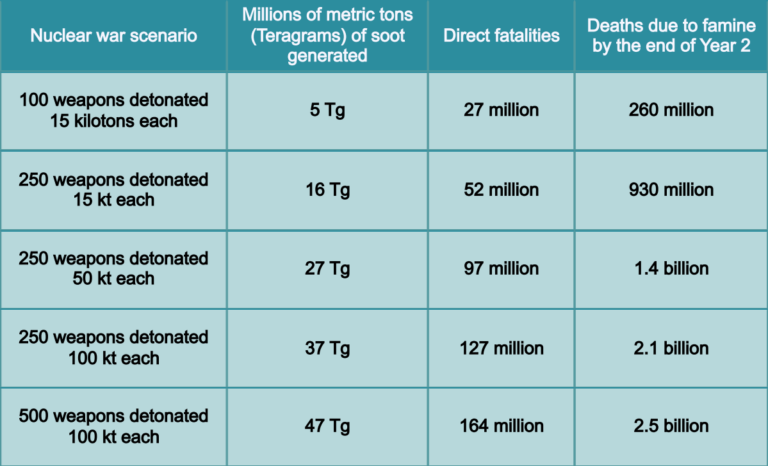
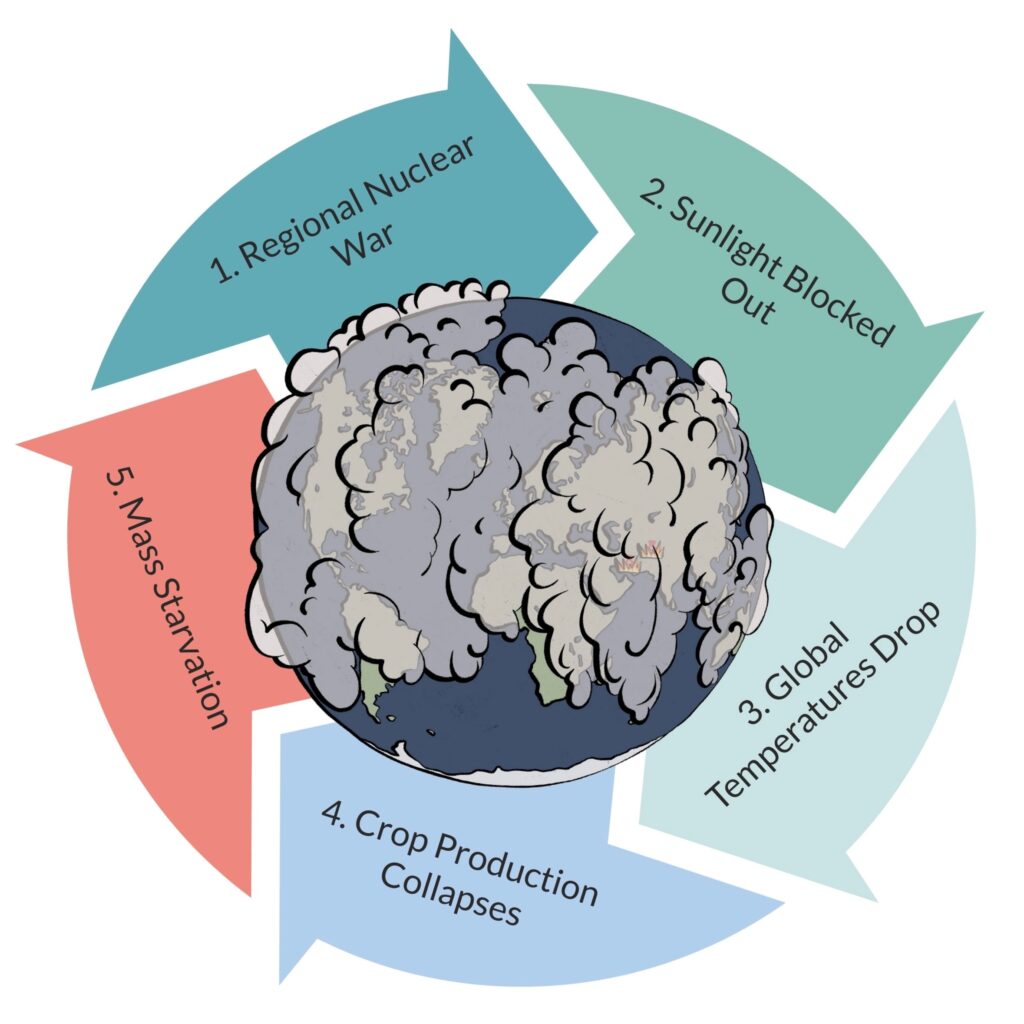
A nuclear war using as few as 100 weapons anywhere in the world would disrupt the global climate and agricultural production so severely that the lives of more than two billion people would be in jeopardy from mass starvation. IPPNW has been involved in several landmark reports summarizing the latest scientific work that shows the extreme reach and consequence of even a nuclear exchange involving a “limited” number of weapons detonating in a specific regional area.
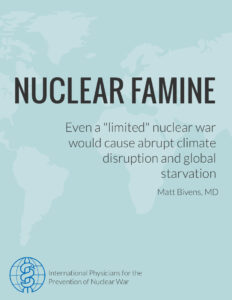
A landmark report, Nuclear Famine (2022), published by IPPNW summarizes the latest scientific work which shows that a so-called “limited” or “regional” nuclear war would be neither limited nor regional. A war that detonated less than 1/20th of the world’s nuclear weapons would still crash the climate, the global food supply chains, and likely public order. Famines and unrest would kill hundreds of millions, perhaps even billions. The findings come at a time of greatly heightened tensions among nuclear states and amid warnings that we are closer to nuclear war than we have ever been.
What is nuclear winter?
The fires caused by a nuclear explosion cause massive amounts of smoke and air pollution. The smoke clouds from multiple nuclear detonations would block sunlight and, in many cases, cause dramatic climatic and temperature drops. The extent of the smoke and climate change could plunge the globe very quickly into a nuclear winter, arresting global food supply chains and causing extensive famine. The findings of Nuclear Famine suggest that the famines would cause hundreds of millions of deaths.
Summary
Using less than 3% of the world’s nuclear weapons, a nuclear war between India and Pakistan could kill up to every 3rd person on earth, with average global temperatures dropping about 1.3 degrees Celsius.
The strongest caloric reductions due to abrupt cooling after a nuclear war are found over the high latitudes in the Northern Hemisphere. Nations such as Canada, Finland, Norway and Sweden would be heavily affected.
A full-scale nuclear war between the United States and Russia would kill an estimated 5 billion people worldwide within two years.
Listen to Dr. Ira Helfand outline nuclear famine:
Specific Findings
Global crop production decline:
- Corn production in the US would decline by an average of 10% for an entire decade, with the most severe decline (20%) in year 5. Soybean production would decline by about 7%, with the most severe loss, more than 20%, in year 5.
- Chinese winter wheat production would fall 50% in the first year and, averaged over the entire decade after the war, would be 31% below baseline.
- There would be a significant decline in middle season rice production in China. During the first 4 years, rice production would decline by an average of 21%; over the next 6 years the decline would average 10%.
Compounding issues:
- Increases in food prices would make food inaccessible to hundreds of millions of the world’s poorest. Even if agricultural markets continued to function normally, 215 million people would be added to the rolls of the malnourished over the course of a decade.
- Significant agricultural shortfalls over an extended period would almost certainly lead to panic and hoarding on an international scale, further reducing accessible food.
- The 925 million people in the world who are already chronically malnourished (with a baseline consumption of 1,750 calories or less per day), would be put at risk by a 10% decline in their food consumption.
- More than a billion people additional people in China would also face severe food insecurity. The total number of people threatened by nuclear-war induced famine would be well over two billion.
In the case of a nuclear war, there is no possible treatment after the fact. We must focus on prevention. And the only way to ensure that nuclear weapons are never used is to eliminate them completely. The United Nations Treaty on the Prohibition of Nuclear Weapons provides the legal and moral foundation for the eradication of nuclear weapons.
Additional Resources
For more information about IPPNW’s work to educate the public and policy makers about the medical, environmental, and humanitarian consequences of nuclear war, contact Molly McGinty